
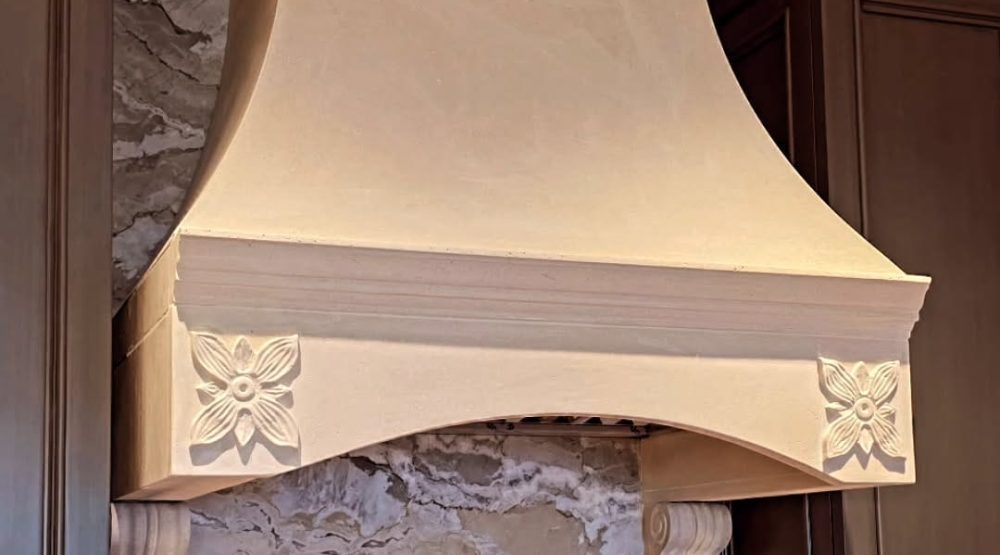
There is a moment in a beautifully designed kitchen when the eye settles on one defining element. It might be an extraordinary slab of marble, a wall of meticulously crafted cabinetry, or an unexpected piece of art. Increasingly, in some of the most considered luxury interiors, it is the range hood.
A custom stone range hood occupies an unusual place between architecture and sculpture. It performs an essential function, yet its scale and position give it the opportunity to establish the visual language of the entire room. When carved by hand from natural limestone or marble, it becomes something more enduring than a kitchen feature—it becomes part of the architecture.
When the Range Hood Becomes the Starting Point
Kitchen design often begins with cabinetry, countertops, or appliances. But a hand-carved stone range hood invites a different approach.
Its proportions can establish symmetry. Its material can influence the surfaces selected around it. Its silhouette can introduce curves into an otherwise linear room or provide structure within a softer interior.
Rather than asking a range hood to disappear into the cabinetry, stone gives designers permission to let it command attention.
The result can be dramatic without being ostentatious. Much depends on proportion, restraint, and the character of the stone itself.
The Architectural Presence of Limestone
Limestone brings a particular softness to the kitchen. Its warm, understated tones complement painted cabinetry, natural woods, unlacquered metals, and richly veined countertops without competing with them.
For a traditional interior, limestone lends itself beautifully to carved corbels, moldings, and architectural profiles influenced by European design. In a contemporary kitchen, the same material can be pared back to its simplest form, allowing scale and texture to provide the impact.
Atelier Jouvence’s range hood collection demonstrates just how varied that vocabulary can be. The Montrachet range hood, for example, uses a gently curving lintel and substantial curved corbels to create a distinctly architectural composition, while other designs take a quieter, more restrained approach.
Marble Brings Its Own Kind of Drama
Where limestone tends to whisper, marble can speak more boldly.
Natural veining introduces movement before a single decorative detail is carved. A carefully selected marble range hood can therefore feel highly sculptural even when its silhouette is remarkably simple.
This makes marble particularly compelling in modern luxury kitchens, where fewer materials are often asked to do more. Against restrained cabinetry and clean architectural lines, the natural movement of the stone becomes decoration in its own right.
Atelier Jouvence offers a selection of limestone and marble options for custom projects, allowing the material to be considered alongside the larger palette of the room rather than selected in isolation.
Hand Carving Creates What Manufacturing Cannot
A stone range hood may appear perfectly composed when finished, but its refinement is the result of countless decisions made during the carving process.
The depth of a molding changes how it catches afternoon light. The radius of a curve can make a substantial piece feel unexpectedly graceful. A carved corbel can be ornamental and expressive or reduced to an almost abstract architectural gesture.
These details are difficult to separate from the hand of the artisan.
Under the direction of French Master Stone Carver Olivier Dumont, Atelier Jouvence uses traditional French stone carving techniques to create each piece. Rather than reproducing a manufactured surface, the process allows the material and the design to evolve together.
A closer look at how stone fireplaces and range hoods are hand carved reveals the progression from raw natural stone to finished architectural form.
A Conversation Between Stone, Cabinetry and Architecture
The most successful custom range hoods do not exist independently from the kitchens around them.
Scale matters. So does ceiling height. Cabinet proportions, countertop thickness, backsplash material, lighting, and sightlines into adjoining rooms can all influence the design.
This is where customization becomes particularly valuable. Instead of choosing a predetermined range hood and adapting the kitchen around it, the stonework can be developed specifically for the architecture.
Atelier Jouvence works with interior designers, architects, builders, and homeowners on custom stone elements conceived for individual spaces, allowing details and dimensions to be tailored to the larger design.
Beyond the Kitchen Trend Cycle
Kitchens are particularly vulnerable to trends. Cabinet colors change. Hardware finishes move in and out of favor. Appliances become more technologically sophisticated.
Natural stone operates on a different timeline.
A thoughtfully proportioned limestone or marble range hood can remain relevant through multiple iterations of the room around it. Like a fireplace mantel or a piece of architectural carving, its value comes partly from the sense that it was designed to belong there permanently.
This is also what separates handcrafted stone from more temporary decorative treatments. As explored in Atelier Jouvence’s look at custom versus prefabricated stone, true custom work is shaped around the architecture rather than selected to fit it.
Creating a Custom Stone Range Hood with Atelier Jouvence
A range hood does not have to be something a designer works around. In the right hands, it can be the element the room is designed around.
Atelier Jouvence Custom Stoneworks hand carves custom limestone and marble range hoods in its Chicago studio for residences throughout the United States. From richly detailed European-inspired pieces to contemporary forms defined by proportion and material, each design is created specifically for its setting.
Explore the stone range hood collection for inspiration, or contact Atelier Jouvence to begin a custom project.
