
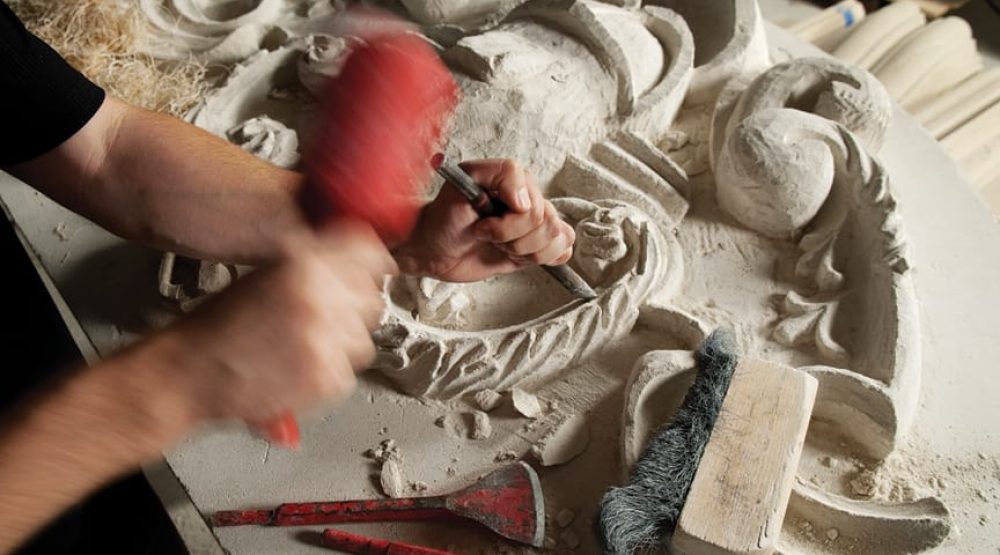
Before a fireplace mantel commands a room or a stone range hood becomes the centerpiece of a kitchen, there is simply stone: substantial, imperfect, and waiting to reveal its form.
Transforming that material into architecture is a process that has changed surprisingly little at its most fundamental level. Tools have evolved, certainly, but traditional stone hand carving remains dependent on something technology cannot replace—the judgment of the artisan.
Atelier Jouvence Custom Stoneworks brings that tradition to custom stone fireplaces, hand-carved stone range hoods, and architectural pieces created for residences throughout the United States.
French Stone Carving Is a Learned Language
Traditional carving is about considerably more than knowing how to use a chisel.
The carver must understand the material—how a particular stone responds, where it can accept detail, how deeply it can be worked, and when restraint will produce a better result.
There is also architecture to consider. Moldings, curves, ornament, symmetry, and proportion have their own visual language. The artisan must understand how those elements relate before attempting to create them in stone.
Olivier Dumont, the French Master Stone Carver behind Atelier Jouvence, was trained in traditional French carving techniques by accomplished European stone carvers. Born in Dijon, France, he is among a small number of French master stone carvers practicing in the United States today.
The Process Begins Before the First Cut
Every custom piece begins with design.
For a fireplace, that means considering the opening, mantel proportions, room dimensions, architectural style, and surrounding materials. A range hood must similarly relate to cabinetry, ceiling height, cooking equipment, ventilation requirements, and the overall composition of the kitchen.
The design determines not only what will be carved, but how the finished stone will inhabit its surroundings.
Selecting Limestone or Marble for Hand Carving
Natural stone is never completely uniform, and that is part of its appeal.
Limestone has long been associated with architectural carving because of its warm character and ability to accept both restrained profiles and intricate details. Marble introduces its own visual language through veining, coloration, and a refined surface.
The choice is therefore both technical and aesthetic.
Atelier Jouvence offers a range of natural limestone and marble options, with stone selected according to the requirements and character of the individual project.
From Raw Stone to Architectural Form
The early stages of carving are about establishing form.
Material is removed to create the fundamental dimensions and silhouette of the piece. At this point, the carver must already be thinking several steps ahead. Stone removed cannot simply be put back; every cut must respect what the finished piece is intended to become.
As the form emerges, the work becomes progressively more refined. Architectural profiles take shape. Curves are established. Moldings become crisp. Decorative carving, when present, begins to acquire depth.
The Details That Reveal the Hand of the Artisan
It is often in the smallest transitions that hand carving becomes most apparent.
A molding may appear simple from across a room, but its depth determines how it interacts with light. The sweep of a corbel influences the visual weight of a range hood. A slight softness along the edge of limestone can make an otherwise formal mantel feel as though it has belonged to the home for generations.
These are not merely decorative decisions. They affect the way the architecture is experienced.
Carving a Custom Stone Fireplace
A hand-carved fireplace offers an unusually broad canvas for architectural expression.
Classical designs may incorporate layered moldings, columns, corbels, or sculptural ornament. Contemporary fireplaces often ask for something more restrained, placing greater emphasis on scale, material, and exact proportion.
In both cases, customization allows the stonework to respond directly to the room rather than requiring the room to accommodate a standard surround.
This difference is explored further in Custom vs. Prefabricated Stone: What’s the Difference?.
Carving a Stone Range Hood
A custom stone range hood presents its own architectural challenge.
It must establish a strong visual presence without overwhelming the kitchen. Its dimensions must relate precisely to cabinetry and cooking surfaces, while the stone exterior must work in concert with the appropriate ventilation system.
Curved lintels, corbels, moldings, and sculptural forms can give the hood a distinctly European character. Alternatively, simplified profiles allow limestone or marble to become the primary visual statement.
The same traditional carving knowledge supports both.
Why Hand Carving Still Matters
Modern fabrication can create extraordinary precision. But precision and craftsmanship are not always synonymous.
The value of hand carving lies partly in interpretation—the ability of an experienced artisan to respond to the material rather than simply reproduce a predetermined shape.
It also leaves room for individuality. Natural stone varies. Architecture varies. Homes vary. The hand of the carver allows those differences to become part of the finished work rather than something to be engineered away.
Traditional Stone Craftsmanship at Atelier Jouvence
Atelier Jouvence Custom Stoneworks preserves traditional French stone carving while creating pieces for contemporary American homes. Under Olivier Dumont’s direction, the Chicago-area studio produces hand-carved fireplaces, range hoods, furniture, and custom stone elements for homeowners, interior designers, architects, and builders nationwide.
Explore hand-carved stone fireplaces and custom stone range hoods, or contact Atelier Jouvence to discuss an original stone project.
